Introduction
- Thyroid nodules are increasingly common in older adults; most are benign.1
- In patients “>=”75 years, malignant nodules often behave more aggressively, making accurate risk stratification essential.
- The Afirma Genomic Sequencing Classifier (GSC) is an exome-enriched RNA-seq assay validated in adults “>=”21 years that refines malignancy risk in Bethesda III/IV nodules, potentially avoiding unnecessary surgery.2
- Limited data exist on the genomic and transcriptomic landscape of thyroid nodules in patients “>=”75 years.
- The goal of this study was to characterize the molecular and transcriptomic profiles of thyroid nodules in patients “>=”75 years compared with younger cohorts.
Methods
- The Afirma GSC database was queried from August 2017 – June 2024.
- Nodules that had adequate genomic material from follicular cells were identified to analyze expressed variants and fusions among Afirma GSC-(S)uspicious and nodules with Bethesda V/VI cytology.
- Nodules from patients <20 yrs were excluded.
- TERT promoter mutations were analyzed from March 2023 – June 2024.
- A subset of samples with available transcriptomic were analyzed for ERK and EMT signaling expression, the BRAF-RAS (BRS) score, and expression of the Human Molecular Signatures Database (MSigDB) hallmarks of cancer pathways.
- Patients were stratified into the following age cohorts:
- 20-54 yrs
- 55-74 yrs
- “>=”75 yrs
Results
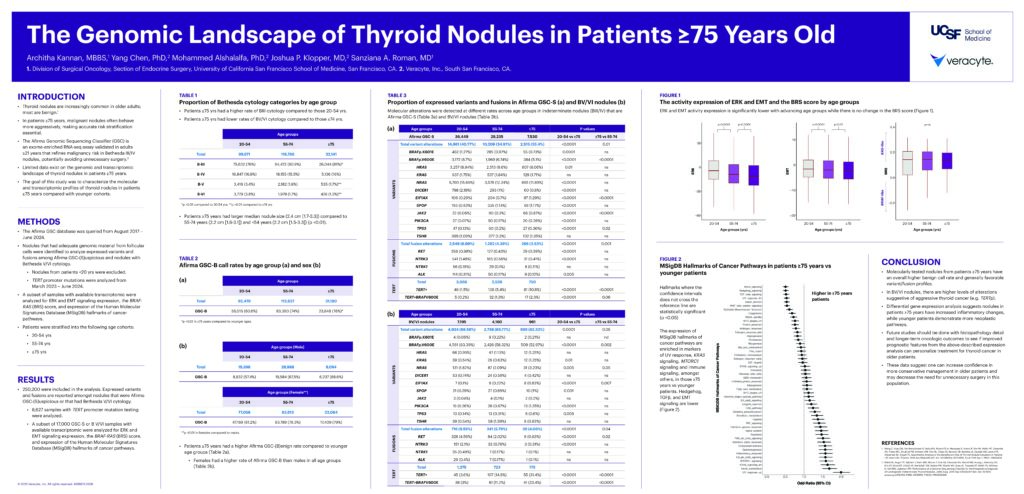
250,200 were included in the analysis. Expressed variants and fusions are reported amongst nodules that were Afirma GSC-(S)uspicious or that had Bethesda V/VI cytology.
- 8,627 samples with TERT promoter mutation testing were analyzed.
- A subset of 17,000 GSC-S or B V/VI samples with available transcriptomic were analyzed for ERK and EMT signaling expression, the BRAF-RAS (BRS) score, and expression of the Human Molecular Signatures Database (MSigDB) hallmarks of cancer pathways.
Patients “>=”75 years had a higher Afirma GSC-(B)enign rate compared to younger age groups (Table 2a).
Females had a higher rate of Afirma GSC-B than males in all age groups (Table 2b).
Conclusion
- Molecularly tested nodules from patients “>=”75 years have an overall higher benign call rate and generally favorable variant/fusion profiles.
- In BV/VI nodules, there are higher levels of alterations suggestive of aggressive thyroid cancer (e.g. TERTp).
- Differential gene expression analysis suggests nodules in patients “>=”75 years have increased inflammatory changes, while younger patients demonstrate more neoplastic pathways.
- Future studies should be done with histopathology detail and longer-term oncologic outcomes to see if improved prognostic features from the above-described expression analysis can personalize treatment for thyroid cancer in older patients.
- These data suggest one can increase confidence in more conservative management in older patients and may decrease the need for unnecessary surgery in this population.
Conference Materials
Afirma Thyroid
The Genomic Landscape of Thyroid Nodules in Patients ≥75 Years Old
Kannan A, et al. ATA. 2025.