Introduction
- The primary role for thyroid nodule molecular testing is to risk stratify nodules with indeterminate cytology (ITN – those with (B)ethesda III/IV cytology).
- The primary objective is to find molecularly benign nodules and thus avoid unnecessary diagnostic surgery.
- Molecular testing may also provide prognostic information in ITN when suspicious for thyroid cancer.
- For BV/VI thyroid nodules, the main goal of molecular testing is to obtain prognostic information.
- The Afirma Genomic Sequencing Classifier (GSC) is an exome-enriched RNA sequencing test that utilizes genomic classifiers to risk stratify ITN and reports on expressed variants and fusions in Afirma GSC-(S)uspicious nodules and in nodules with BV/VI cytology).
- Expressed variants and fusions are reported as part of the Afirma Xpression Atlas (XA).
- The Afirma Genomic Resource for Intelligent Discovery (GRID) is a research use only tool that contains mRNA based molecular signatures and data points beyond expressed variants and fusions that may provide molecular data for research to improve upon the current prognostic information associated with clinically reported data.
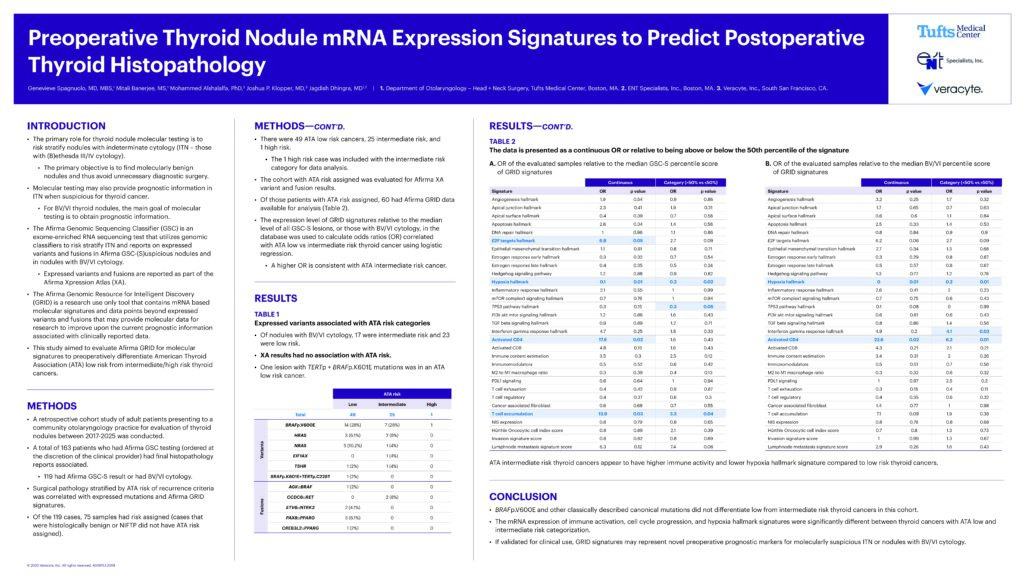
- This study aimed to evaluate Afirma GRID for molecular signatures to preoperatively differentiate American Thyroid Association (ATA) low risk from intermediate/high risk thyroid cancers.
Methods
A retrospective cohort study of adult patients presenting to a community otolaryngology practice for evaluation of thyroid nodules between 2017-2025 was conducted.
A total of 163 patients who had Afirma GSC testing (ordered at the discretion of the clinical provider) had final histopathology reports associated.
- 119 had Afirma GSC-S result or had BV/VI cytology.
- Surgical pathology stratified by ATA risk of recurrence criteria was correlated with expressed mutations and Afirma GRID signatures.
- Of the 119 cases, 75 samples had risk assigned (cases that were histologically benign or NIFTP did not have ATA risk assigned).
Conclusion
- BRAFV600E and other classically described canonical mutations did not differentiate low from intermediate risk thyroid cancers in this cohort.
- The mRNA expression of immune activation, cell cycle progression, and hypoxia hallmark signatures were significantly different between thyroid cancers with ATA low and intermediate risk categorization.
- If validated for clinical use, GRID signatures may represent novel preoperative prognostic markers for molecularly suspicious ITN or nodules with BV/VI cytology.
Conference Materials
Afirma Thyroid
Preoperative Thyroid Nodule mRNA Expression Signatures to Predict Postoperative Thyroid Histopathology
Spagnuolo G, et al. ATA. 2025.